Sunday, July 17, 2011

The Internet Just Had Its Doors Blown Off

A few weeks ago, the "Powers That Be" that control various aspects of the internet decided to do away with perhaps the most defining piece of the internet: .com .

The Internet Corporation for Assigned Names and Numbers (ICANN) is the organization that is ultimately in charge of distributing internet names and IP addresses.  They are the ones that enforce the use of .com, .net, .org, and everything else.

And so, on June 20th, ICANN announced that it was opening up the internet to almost anything.  For the first time, an internet address doesn't have to end in ".com" or ".net" or ".au".  Instead, it could end in ".john" or ".smith", if an enterprising John Smith wanted to pony up the $185,000 to register his own top level domain.

At first, I was "meh" about this story.  Who's going to sign up for this, and what will it do for them?  Take a prior example: the small western Pacific country of Tuvalu was given the country code of ".tv" in 1998.  (Each country gets its own country code for country-specific things on the internet: .au for Australia, .uk for the United Kingdom, .ad for Andorra ... there's a whole list here)  Businesses lined up behind Tuvalu to "rent" some of their .tv space, with the thinking that it would be really cool to have sites like www.cheers.tv or www.jeopardy.tv -- that all your favorite tv shows would have a .tv address.

But it hasn't really turned out to be all that popular, and Tuvalu appears to have gotten short-changed in the process.

So, at first, I was pretty "meh" about the whole thing.  A nice idea, a $185,000 price tag to keep out spammers and the lowly bloggers like myself, and a limit of 1,000 new top-level domains per year.  Who would sign up for this?

The answer: almost every tech savvy company out there.  Think about it:

  • ipod.apple
  • search.google
  • www.movies.sony
  • mickey.disney
  • www.HugeOilSpill.bp

You get the point.  Big businesses will have the opportunity to closely align the company name with their product on the internet.  And, depending on how ICANN sets it up, you may even be able to dispense with the www stuff -- simply type in "twitter" in your browser, and you'll be taken straight to Twitter's home page.

The era of ".com" will seem quaint in 5 years.

Monday, July 4, 2011

Driving in DC #8

This one goes back all the way to my very first post on Driving in DC.  I mentioned that DC is laid out on a grid with numbered streets running north-south, and lettered streets running east-west, and stated that this was nearly a wonderful idea.  This post will explain my use of the "nearly."

So, letters go east-west, and numbers go north-south.  Something like this:


Seems simple, right?  Kind of like Manhattan's grid system, where the avenues go north-south and the streets go east west, Washington, DC should be a similarly easy place to navigate?

Wrong.

The problem is, in Pierre L'Enfant's twisted mind, it was perfectly logical to place the origin of the coordinate system smack dab in the middle of the city: the US Capitol.  Thus, four quadrants are established.  Suddenly, instead of just an intersection, you now need a third piece of information to find the destination you're looking for.  (And, of course, the city designers were not so mathematically inclined so as to include negative numbers and negative letters in their street naming convention.)

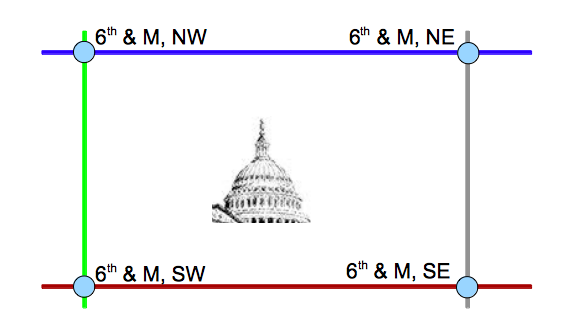
To illustrate, let's say you're new in town, you've heard great things about the new Arena Stage, and a friend told you it's at the intersection of 6th and M.  If that's all you know, you have a 25% chance of finding the right spot on your first guess.


  • 6th and M NW is basically one block over from the Convention Center.  
  • 6th and  NE is almost the main entrance to Gallaudet University.  
  • 6th and M SE, technically, doesn't exist (6th street is blocked by the new Marine Barracks) but it's the entrance to the Chief of Naval Operation's house at the Navy Yard.
  • 6th and M SW is the Arena Stage.


This may seem trivial or minor, but when I used to live in Southwest DC, three or four times per year I would have to redirect some poor lost soul who had mistakenly wandered into the wrong quadrant.  People who live in DC or have to navigate there often learn to instinctively pick up on the "NW" or "NE" label (or just assume NW if there is no other distinguisher), but for any newcomer, beware.  It makes a BIG difference.

Thursday, May 26, 2011

Acting Like a PhD

Just a random thought after a long day on the streets of DC -- one in which I have burned through almost 100% battery life of a Blackberry in 1 day, doing only email, text, and 2 hours of phone calls.

So, what is "acting like a PhD"?

Acting Like a PhD:  when one is relentlessly focused on the singular pursuit of a miniscule detail, yet claiming that the success or failure of the entire project / company / world hinges on that detail. 
When, in fact, it doesn't.

Thursday, April 28, 2011

Earthlings Got Nuclear Power Development Backwards

This post is a bit more right-brained than usual.

I do the morning feedings for Bethany, so it gives me some time to daydream in the wee early hours of the morning.  For better or for worse, one of those daydreams goes along the lines of, "How did civilization get to where it is today, and how else could it have gone?"  Please bear with me as I go through a tortured logic path.

1.  I have a hard time believing that Earth is really all that unique.

If you believe the Drake Equation, it's pretty easy to convince yourself that there is at least one other civilization out there, somewhere, that is going through a similar experience right about now.  That previous link provides a cool calculator with which you can enter values you think are appropriate for our galaxy, and determine how many other civilizations might be in our own galaxy.  When you start with a population of 100 billion stars in our galaxy, you have to make some very pessimistic assumptions about some things to make Earth the only intelligent life out there.  So, how are they doing?  How does their development compare to ours?

2.  It's reasonable to assume that another civilization would stumble upon nuclear power, eventually.

Earth like planets out there could have uranium deposits that would have formed from a supernova explosion, just as how Earth's were formed.  Uranium 235 will fission in exactly the same way here as it would on Tatooine.  Smart scientists could presumably mine up the yellowcake stuff (it's very unique) and start playing with it.

3.  But we Earthlings stumbled upon nuclear power in a very unique way.


World War II was the single biggest driver for the development of All Things Nuclear.  According to Richard Rhodes' outstanding book The Making of the Atomic Bomb, in 1944, the nuclear industry was as big as the US automotive industry at the time.  And yet nobody knew about the nuclear industry; it was entirely secret, and entirely focused on making a nuclear weapon.  Entirely focused with a lot of resources behind it.

The US was hell-bent on developing a nuclear weapon, because the US was panicked that Germany would get there first.  Albert Einstein wrote a famous letter to President Roosevelt, begging him to take action to develop a nuclear weapon.  When it turned out that Germany had stopped its program to develop a nuclear weapon (thanks to a miscalculation [?] by Werner Heisenberg), the prospect of a nuclear weapon then became a convenient way to end the war in Japan without an invasion of the island.

The first nuclear weapon was exploded at the Trinity Site on July 16, 1945.  Here's a picture of me at the site:

It wasn't until August of 1956 -- over eleven years later -- when the first full-scale power reactor was connected to the power grid, in England.  (Sorry, technophiles, EBR-I doesn't count in my book.)  This, despite the fact that the first critical pile -- in effect, the world's first nuclear reactor* -- went critical in December 1942.

Thus, for almost a decade and a half, the benefits of nuclear power were dedicated solely to the production of materials for nuclear weapons.  So how was nuclear power unveiled to the world?  Through the terrible destruction witnessed at Hiroshima and Nagasaki, mushroom clouds, and the threat of total annihilation.

I propose that this is exceptional; that the development of nuclear power under these circumstances was a statistical oddity, and that almost any other civilization would have stumbled upon nuclear power under less desperate circumstances.  That, perhaps, another society would have stumbled upon nuclear power (probably similar to how Lise Meitner and Otto Frisch came upon it), and said, "Wow!  This is pretty neat stuff!  It's a million times more energetic than any chemical release of energy!"

And thus, the benefits of nuclear power could be brought into the world, without the iconic and terrifying images of mushroom clouds being seared into the civilization's psyche.


Obviously, the recent events in Fukushima have influenced my thinking.  That story has gripped the world's news headlines for a month now, but some other stories with severe economic impacts have gotten much less attention.  Just for one example, a sewage treatment plant failed, killing two workers and releasing up to 4 million gallons of sewage into the nearby river.   Fishing and swimming were prohibited; the TVA had to release extra water from an upstream dam to dilute it more.

Or the natural gas explosions that happen occasionally: a natural gas plant exploding in Connecticut and killing 5; a natural gas pipeline exploding in California and killing 4; there are many examples.

Or, as an even bigger environmental incident, there was the coal ash spill from the Kingston Fossil Plant in Tennessee, which released 1.1 billion gallons of coal ash (laden with heavy metals and carcinogens) in 2008.  Hundreds had to be evacuated because their homes were destroyed, and the deposits it left behind make many areas uninhabitable.

Oh, by the way: BP expects to start drilling again the Gulf of Mexico later this year.

Accidents like the above happen all the time.  Society continues on with the mindset that these are terrible accidents that should be corrected, but are not calling for the end of those industries.  I am not trying to say that the above examples are equivalent to the Fukushima accident. (I have my opinions on that, but in this case, I'll keep my opinions to myself and avoid the Internet Flame War that would result.)  The purpose of this post is to provide a plausible explanation for why there is such a visceral response to commercial nuclear power: it was born under a mushroom cloud, and has been trying to get away from that image ever since.

That visceral fear is stunting our growth.  I think other alien races would find us silly in that regard.

_________________________________________
*Okay, technically, the second.  There is a fascinating account of a naturally occurring nuclear reactor at a site called Oklo in Gabon, Africa.  This happened about 2 billion years ago, but nobody was around to see it.

Thursday, April 14, 2011

Budget Cuts: Are They Real?

There were two articles recently in the WaPo that caught my interest:

This one, where the CBO finds that the $38 billion isn't all from direct program cuts, and an insightful opinion piece by Ezra Klein on how the $38 billion can be reduced as far as $350 million if you slice it right.

The headline is indeed attention grabbing -- did the politicians really swindle us into thinking they had made a fairly significant cut, when all they had been doing was a shell game?  But then I read the articles, and found many examples of where spending had been effectively taken away from budget swindlers.  Unfortunately, I have been party to those budget swindles many, many times.

Bottom line: at the end of the day, this will result in some real funding not being spent that would have been spent by government.

The first WaPo article makes mention of a few projects for which funding was no longer necessary: $560 million for an Education Department program that no longer exists (holy moly!  that's huge for DoEd!!), $15 million for a US Capitol building that already exists.

I assure you, department budget weenies had one word on their mind:
Reprogramming.

This happens all the time: money is appropriated for one project, and it either comes in under budget (which actually happens from time to time, you just never hear about it), or the priorities change.  At which point, the money is reprogrammed: it is removed from this project and transferred to that project.  This usually requires a few levels of approval, but unless Congress specifically appropriated the money in Congressional language, departments have a fair amount of authority to shift money around.

Which, ultimately, is a good thing, because you don't want Congress to have to micromanage every department.  They do a crummy enough job managing their own finances, as it is.

So, this budget compromise, among other things, effectively prevents budget weenies from reprogramming the money and spending it elsewhere. Which is a good start.

But, for the record, $38 billion is a drop in the bucket (1%) compared to a $3.6 trillion annual spending budget.  Time to start hitting Social Security, Medicare, Medicaid, and even national defense.

Monday, April 4, 2011

Introducing...

Bethany Grace!!

7 pounds, 5 ounces at 5:37pm on Monday, March 28th.

The birth of a bouncing baby girl (our first) definitely gives you a sense of wonder at the miracle of life.  More musings on this when I can collect my thoughts and get more sleep.

Thursday, March 17, 2011

Driving in DC #7

Time to go back to some regular posting for a bit: this one features the intersection of M Street and Connecticut Avenue, Northwest:


If you're new here, on this blog I sometimes try to document just how head-shakingly bad some of the areas are driving around in Washington, DC.  The topics have covered signage, absurd merge lanes, the ridiculous streets, and everything in between.  If you click on the "driving in dc" tag at the bottom of this post, you'll get all of them.

In the case of M & Connecticut, it's one of the prime examples of where the diagonal street intersections have gone laughably wrong.  It's an impenetrable morass of roads and cross traffic:


This is where M Street, Connecticut Avenue, 18th Street, and Rhode Island Avenue all converge.  I had to laugh out loud the first time I saw the traffic light in the middle of the lane.


Even with Google Maps and Street View, I can't get a good angle that accurately encompasses the acres and acres that this intersection takes up.  But you can click and scroll around to see it all.

View Larger Map

For one more grin, here's the view of the intersection as you're approaching it from Rhode Island.  I don't get it.


Lastly, here's a shot from 18th street, looking back.  The traffic flow describes this pretty well.

View Larger Map

Pictures just don't quite do this one justice.  You have to see it for yourself.

Last Post on Fukushima for a while...

I've had a few, genuine comments from people in the area of the reactors, looking for advice and thanking me for providing some clear insight.   I was writing a response back to one of them when I just decided to make this my (possibly nearly final) post on the Fukushima reactors.

"one cup of coffee" asked,

If you don't mind me asking, I'd like to know what you think? If, as they are saying, they are able to get power to the plants and restore the cooling system will they have saved the plant from dumping more radiation into the environment? At that point will the situation be "under control?" What exactly would it take to get the situation under control? It seems like the foreign press is obsessed with worst case scenarios, what about a reasonable set of most likely scenarios? And lastly, what about the plutonium? Is this significantly more dangerous than the uranium?
and it spawned a whole host of emotions.  Here's my response.

I'd give it another WEEK before we can safely say that we're "out of the woods" and that there will be no more flare-ups.  A recent report I read said that some of the concrete wall surrounding the spent fuel pool of reactor #4 has fallen away, but that the steel liner remains.  If the pool crumbles, my guess is that it would make cleanup considerably messier, but *shouldn't* provide any additional risk to the general public.

Getting reliable power to the site will help tremendously: they may be able to turn on some of the pumps and ensure good water circulation, and they should be able to get a more reliable flow of water to the core.  But even then, the road ahead is a lot of (boring) circulation of water as the core cools down to a point where they can safely inspect it with cameras and robots.


And the plutonium: I've enjoyed looking at what other sites link to mine (thanks Google Analytics!), but some of the sites out there are just absurd.  My jaw dropped at the rampant mis-representation of the facts, and heralding the fact that "Mox fuel is two million times worse than uranium."  Baloney.  Yes, plutonium has a higher toxicity and a lower melting point than uranium, so it's not quite as robust.  It might result in a slightly higher dose to those at the plant (who have tools and equipment to deal with it appropriately), but in no way will it lead to any additional dose to the general public.

Earlier in the comment, "one cup of tea" noted that people have a very visceral response to radiation.  And sadly, that's very true.  Radiation is all around us, and I think people are ignorant of that.  The background radiation you get from the Colorado Plateau is five times higher as on the eastern seaboard, and yet you don't see people fleeing Colorado for the coasts.  And as I noted in a previous post, people are exposed to small amounts of toxic chemicals all the time due to spills and accidents, and yet humanity moves on.  Remember the Union Carbide plant in Bhopal?  A hideous, gruesome release of methyl isocyanate killed thousands and injured tens of thousands, and yet the industry goes on.  I wish the public could put radiation in the same context that almost everything else is, and I guess that starts with education.

Lastly, a comment on frustration: I have read reports from scores of "experts" proclaiming that the Fukushima "crisis" will be worse than Chernobyl and that lives are at risk all around the world.  Where is the accountability?  Where are the apologies when these people are shown to be wrong?  Where is the public excoriation when the "expert opinions" turn out to be nothing more than fear-mongering, playing on the deep-rooted fears of the general public?  When does the loss of credibility set in?

Sadly, it won't.  The nuclear "debate" will continue, fueled more by emotion than by fact when no one in the general public is affected by this event.  And the nuclear "experts" will continue pressing the panic button and gleefully watching the response.  And most of the mainstream media will follow them doggedly because it sells newspapers and it generates interest.

The solution, I think, starts with education.  Patient, careful, instructive education.  I hope I've been able to provide some of that here.

I'll leave with the most recent update from JAIF on the status of the reactors (click for bigger):